
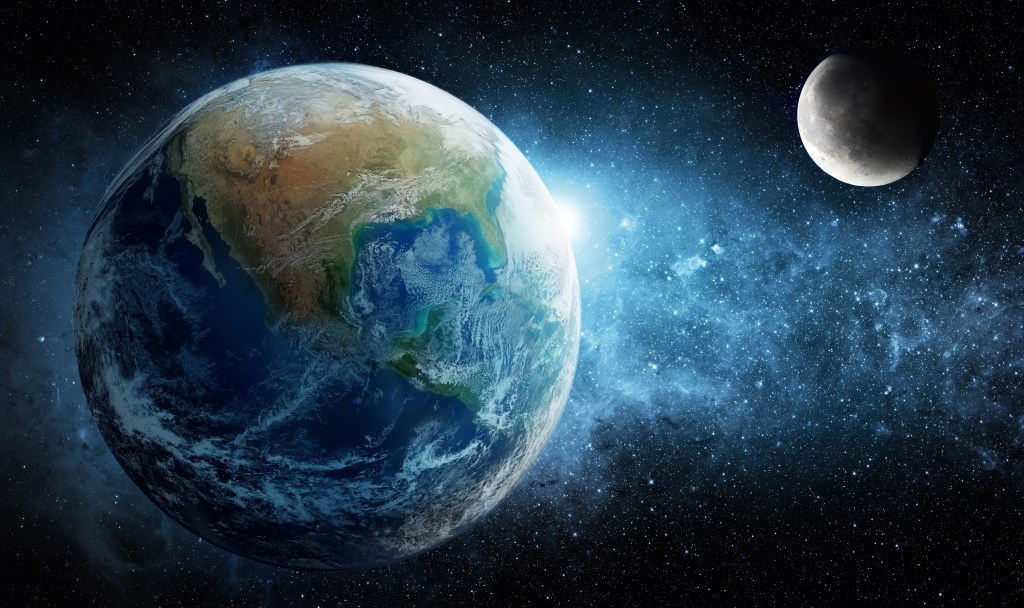
Have you ever wondered why the earth and the moon don’t crash into each other. Think about it… both of these massive objects have gravitational pulls on each other. The earth pulls on the moon, and the moon pulls back on the earth. If they are both pulling toward each other, then why don’t they collide?
The answer to this question is one of the most wonderful and miraculous realities in the universe. And to understand it, we must dive into Physics.
There are two forces in Physics that when held at perfect equilibrium keep the moon and the earth from colliding. The first is Centripetal Force, which is a force that keeps objects in circular motion. Consider tying a string to the end of a pencil and putting a small piece of metal at the other end of the string. Then twirl the pencil around so that the piece of metal twirls in a circular pattern. You will feel a slight force on your hand pulling your hand outwards towards the piece of metal. This is because you are exerting a force on the piece of metal through the string to keep it in circular motion. The force exerted by your hand is a Centripetal Force because it keeps the object in its circular path. If you were to let go of the pencil, the metal piece along with the string and the pencil would fly off in a direction tangent to the circular path. Another example of Centripetal Force is when you are driving around a bend. In this case, the force that is keeping your car on the curved road is the Surface Friction between the road and your tires. This Surface Friction is acting as the Centripetal Force because it keeps you in circular motion, preventing your car from sliding off the road.
In the case of planetary orbits, the Centripetal Force that is keeping the moon from flying away is not your hand, nor friction, but Gravity. The moon is orbiting at an extraordinary rate of 1,022 meters per second (or 2,288 miles per hour). With such a high speed, it seems as though the moon might just continue straight in its tangential direction at thousands of miles per hour and break free from its orbit. And it would — if it wasn’t for the Gravity of the earth keeping it around. This means that the magnitude of the Force of Gravity of the earth upon the moon (the number of Newtons of force) must be greater than or equal to the amount of Centripetal Force needed to keep the moon in its orbit.
On the other hand, the Force of Gravity of the earth upon the moon must not be too great, otherwise the moon and the earth would crash into each other. In fact, all of the Force of Gravity must be “used up” in providing Centripetal Force to keep the moon in orbit, so that there is none left over to pull the moon towards the earth. In other words, the Force of Gravity must be equal to the Centripetal Force. They must be at beautiful equilibrium. And this is where we start to see God’s handiwork in His creation. For if the moon were moving at just a slightly higher velocity, then the Centripetal Force needed to keep it in orbit would be greater than the force that Gravity could provide, and the moon would fly away. And if the Force of Gravity was slightly larger, then the moon would slam into us. But, as it is, the earth and the moon are perfectly positioned with just the right amount of velocity and gravity to keep everything at rest. And how did this happen? The only answer is God.
In Genesis 1:16-18, God made the sun and the moon. “God made the two great lights — the greater light to have dominion over the day and the lesser light to have dominion over the night — as well as the stars. God placed them in the expanse of the sky to provide light on the earth, to dominate the day and the night, and to separate light from darkness. And God saw that it was good.”
And in Colossians 1:16-17, speaking of Jesus Christ, Paul writes:
“For everything was created by Him,
in heaven and on earth,
the visible and the invisible,
whether thrones or dominions
or rulers or authorities —
all things have been created through Him and for Him.
He is before all things,
and by Him all things hold together.”
We see in God’s Word that not only did Jesus create the earth and the moon, but “by Him all things hold together.” This truth comes to life when we consider another type of object that orbits the earth: Satellites. As of 2024, there are over 10,000 active Satellites orbiting earth, most being used for communications. Just like the moon, in order for these Satellites to stay in orbit and not fly away or fall back down, they also must be held at equilibrium. Since they are closer to the earth than the moon, the force of Gravity acting upon them is greater, thus they must be moving at a faster velocity (17,000 miles per hour on average) in order to require enough Centripetal Force to “use up” all of that Gravity. In order to maintain the perfect velocity, engineers equip Satellites with a propulsion system. Picture multiple thrusters on various sides of the Satellite that fire when they detect the Satellite is moving too quickly or too slowly to bring the Force of Gravity and the Centripetal Force back to equilibrium. This is how Satellites stay in orbit.
Understanding how Satellites are sustained in orbit leaves us with a question: what is the moon’s propulsion system? The moon doesn’t have rocket thrusters attached to its sides to maintain just the right velocity. So how does it stay in orbit? Again, the only answer is God. For Jesus did not just create all things, but He is actively and personally involved in every inch of His universe. As Colossians 1:17 says, “by Him all things hold together.” While it isn’t wrong to picture God’s hands correcting the speed of the moon, keeping it from flying away or crashing down, we can also observe this intentional act of God through science. There are likely a million means that God uses to sustain the moon’s circular path. And I encourage you to do your own research, foster your own intellectual curiosity, and dive deeper into Physics. Seek to understand further the means God uses, to marvel at His hands holding all things together, and to behold His glory in planetary orbits.
To schedule a tutoring session with Behold Tutoring for Physics or any subject, please call (502) 509-5546.
 Behold Tutoring
Leave a comment